
In the previous chapter, we covered Time and Work, which provides the foundation for understanding Pipes and Cisterns. Both topics are closely related because they involve the concepts of work, time and rate.
We have organized Pipes and Cisterns into four dedicated chapters: Formulas with Examples and Explanations, Questions with Answers and Solutions, Practice Questions, and Previous Year Questions (PYQs).
So, let us begin with Pipes and Cisterns Concepts.
At MathsbyNITian, you can learn competitive-exam mathematics for free. Explore our Maths Notes, Formula, Practice and PYQs to strengthen your understanding and improve your mathematical skills.
We are building comprehensive mathematics resources for SSC, RRB, Defence, Banking, Police and UPSC CSAT examinations, based on the relevant exam syllabi.
Have a query, need clarification, want to suggest a question or spot an error?
Feel free to contact us. We value your feedback because it helps us continuously improve MathsbyNITian for aspirants.
What are Pipes and Cisterns Problems in Arithmetic?
Pipes and Cisterns is an important topic in Arithmetic, where questions related to filling and emptying tanks are asked in competitive examinations such as SSC, RRB, Banking, Defence and other government exams.
To understand Pipes and Cisterns problems clearly, let us first understand some basic terms that are commonly used in these questions.
Pipe
A pipe is a passage or channel through which water or any liquid flows.
In Pipes and Cisterns problems, a pipe can perform two functions:
- Inlet Pipe: A pipe through which water enters a tank.
- Outlet Pipe: A pipe through which water leaves or is removed from a tank.
Cistern
A cistern is a tank or reservoir used to store water or any liquid.
In these problems, the cistern represents the total capacity or the complete work that needs to be filled or emptied.
Example 1:
Suppose a pipe fills a cistern having a capacity of 6 litres.
If the pipe supplies 5 litres of water, then the cistern will contain 5 litres of water, and 1 litre capacity will still remain empty.
Other Important Terms Used in Pipes and Cisterns Problems
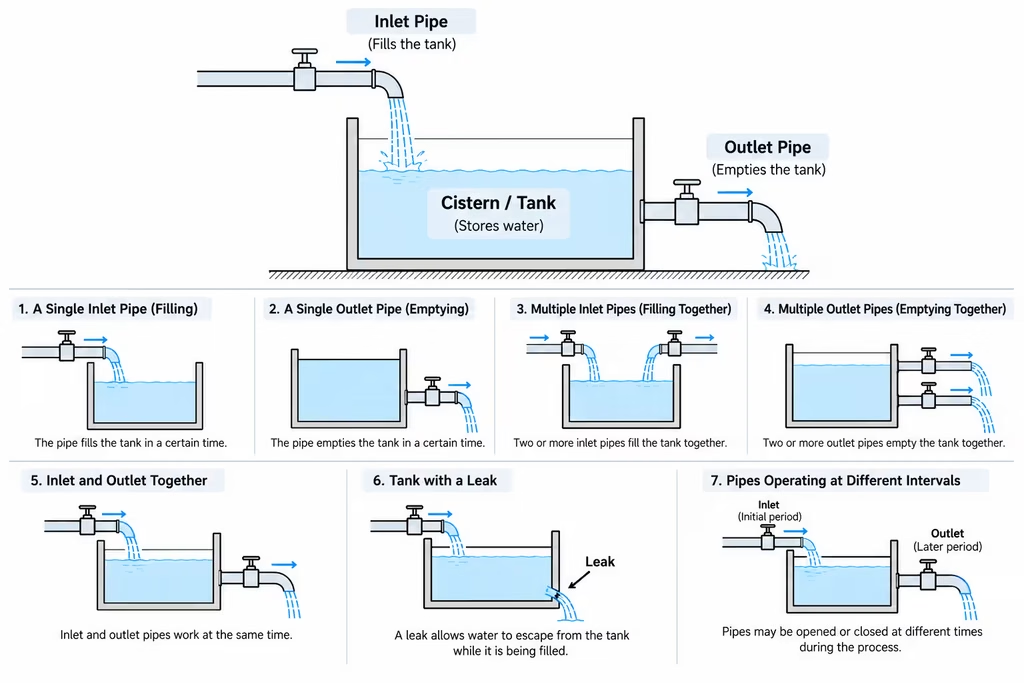
Pipes and Cisterns problems involve different arrangements of inlet pipes, outlet pipes and tanks. A detailed illustration showing these arrangements is given below to help aspirants understand the concepts visually.
1. A Single Inlet Pipe (Filling)
A single inlet pipe is used to fill a cistern. The word inlet means that water is entering the tank.
Example 2: A pipe can fill an empty tank of 600 litres in 6 hours.
2. A Single Outlet Pipe (Emptying)
A single outlet pipe is used to empty a cistern. The word outlet means that water is flowing out of the tank.
Example 3: An outlet pipe can empty a full tank containing 800 litres of water in 8 hours.
3. Multiple Inlet Pipes (Filling Together)
In these problems, two or more inlet pipes are used to fill the same cistern. They may operate together to fill the tank faster taking less time.
Example 4: Two inlet pipes can fill a tank in 6 hours and 3 hours, respectively. If both pipes are opened together, the tank fills in less time.
4. Multiple Outlet Pipes (Emptying Together)
In these problems, two or more outlet pipes are used to empty the same cistern. When opened together, they empty the tank faster than either pipe working alone.
Example 5: Two outlet pipes can empty a full tank in 8 hours and 12 hours, respectively. If both pipes are opened together, the tank empties in less time.
5. Inlet and Outlet Pipes Working Together
Some problems involve both inlet and outlet pipes operating simultaneously. The inlet adds water to the tank, while the outlet removes water from it. Therefore, the tank fills more slowly than it would with the inlet pipe alone.
Example 6: An inlet pipe can fill a tank in 6 hours, while an outlet pipe can empty the full tank in 9 hours. If both are opened simultaneously, the tank takes longer than 6 hours to fill.
6. A Tank with a Leak
In certain problems, a tank has a leak through which water escapes while an inlet pipe is filling it. The leak affects the time required to fill the tank.
Example 7: An inlet pipe can fill a tank in 5 hours when there is no leak. If the tank has a leak, the same pipe takes 6.5 hours to fill the tank.
7. Pipes Operating at Different Intervals
Some problems involve pipes that are opened or closed at different times. For example, an inlet pipe may fill a tank for a certain period before an outlet pipe is opened, or different pipes may operate alternately during the process.
Example 8: An inlet pipe can fill a tank in 6 hours. It is opened for 2 hours and then closed. An outlet pipe is then opened to empty the remaining water from the tank.
Work Rate of Pipes
In the Time and Work section, we learned that the time required to complete a task is inversely proportional to the number of people working, assuming they have the same efficiency.
For example, if one person completes a task in 10 days, two people with the same efficiency can complete it in 5 days.
The same principle applies to Pipes and Cisterns.
If the flow rate increases, either by increasing the number of inlet pipes or using pipes with a higher flow rate, the cistern will fill faster.
Let us understand this mathematically.
If a pipe fills a cistern in 10 hours:
- In 1 hour, it fills 1/10 of the cistern.
- In 2 hours, it fills 2/10 of the cistern.
- In 5 hours, it fills 5/10 of the cistern.
- In 10 hours, it fills the entire cistern.
Now, suppose two identical inlet pipes are used together.
- In 1 hour, both pipes fill 2/10 or 1/5 of the cistern.
- In 2 hours, they fill 4/10 or 2/5 of the cistern.
- In 5 hours, they fill the entire cistern.
But when two or more inlet pipes with different filling capacities work together, their individual work rates are added to determine the combined filling rate.
In the next chapters, Pipes and Cisterns Formulas, we will derive important formulas and learn how to apply them under different conditions. We will also solve various Pipes and Cisterns questions to understand the concepts and formulas from an exam-oriented perspective.
Pipes and Cisterns Practice Questions
In this practice section, you will find Pipes and Cisterns questions covering SSC, RRB, Defence, Banking, UPSC CSAT, and other competitive exams.
Practice a variety of question types, including MCQs, fill in the blanks, true or false, and word problems, to strengthen your concepts and improve your problem-solving skills.
Example 9:
A pipe fills 3/5 of a cistern in 10 minutes. How much time will it take to fill the entire cistern?
Answer: 16⅔ minutes.
Pipes and Cisterns Previous Year Questions (PYQs)
In this section, we solve previous year questions (PYQs) asked in competitive exams such as SSC, RRB, and other government examinations. These questions help you understand how concepts of Pipes and Cisterns are applied in actual exams.
Example 10:
A pipe can fill a cistern in 3 hours. Due to a leak, it takes 4½ hours to fill the cistern. In how many hours can the leak empty the completely filled cistern?
Answer: 9 hours.
How to Prepare Pipes and Cisterns for Competitive Exams
- Understand the basic concepts of inlet pipes, outlet pipes and tanks.
- Learn how individual and combined pipe operations work.
- Study the formulas and understand when to apply them.
- Solve examples and check each solution carefully.
- Attempt practice questions to improve speed and accuracy.
- Solve previous-year questions to become familiar with exam patterns.
- Revisit concepts and question types that you find difficult.
Related Chapters
- Time and Work
- Ratio and Proportion
- Direct and Inverse Proportion
- Percentage
- Arithmetics
- Time, Speed and Distance